

SLOW TRAVEL IN RURAL SPAIN: WHAT IT TRULY MEANS TO MOVE FROM "VISITOR" TO "LOCAL"

Traveling is one of the most enriching human experiences available to us, especially when we embrace slow travel. Yet, looking at the current state of global travel, we see staggering inequalities in where people go, and the footprints travelers leave behind.
According to the latest data from Spain's National Statistics Institute, the country is on track to welcome a record-breaking 100 million tourists this year. However, roughly half of those millions are squeezed into just 1.4% of Spanish territory. While coastal hotspots and major cities wrestle with overcrowding, inflated housing costs, and environmental strain, vast stretches of the country (what many call España Vaciada, or Empty Spain) remain quiet.

Whether tourism becomes a force for destruction or a catalyst for transformation is ultimately on us to decide. How we choose to explore the places we visit has the power to revitalize local economies, protect fragile ecosystems, and preserve time-honored ways of life for generations to come.
The Fast-Track from "Visitor" to "Local" in Rural Spain
I had wanted to visit Spain my entire life, but I didn't want a cookie-cutter vacation. I wanted the most authentic experience of Spanish culture I could find within a limited window of time. That search is what led me to Rooral.
The core thesis of Rooral is simple: bridge the gap between remote workers and small Spanish rural villages through intentional, sustainable tourism.
When I arrived in the Genal Valley, winding through mountain curves past windmills and catching my first glimpse of white-washed villages nested in the hills, I felt instantly teleported. I stepped into a pace of life where everything happens at a slower speed, and where people still know and care about one another.
Usually, moving from the status of a "visitor" to feeling like a "local" takes months, if not years. You have to wander the streets, get lost, establish daily routines, muster up the courage to talk to strangers, and slowly build a network of friends. As a traveler with limited time, that process is nearly impossible, especially if you are naturally on the shy side.
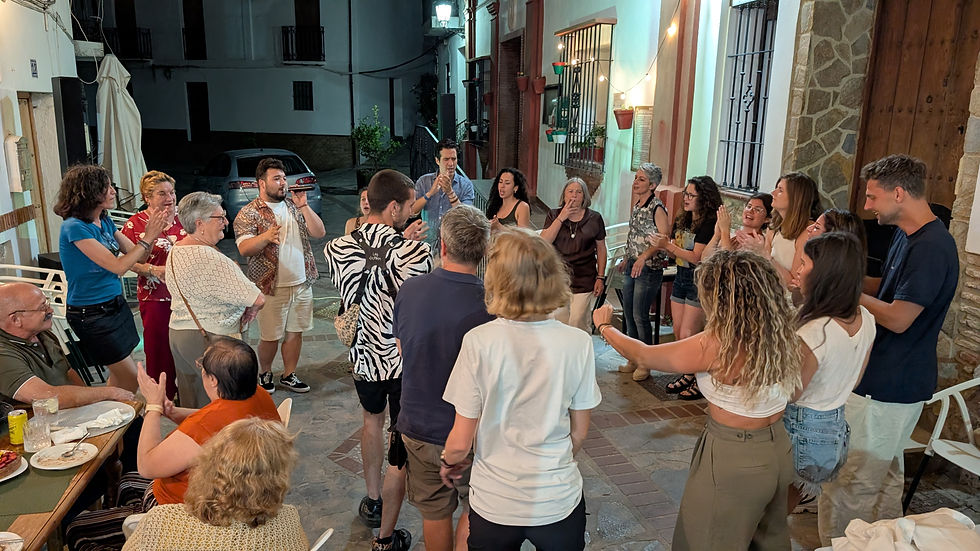
This is where the concept of slow travel changes everything. Instead of rushing through a dozen tourist spots in a week, slow travel invites you to stay in one place long enough to sink into its natural rhythms. Another advantage of traveling to Benarrabá with Rooral is that everyone in town knows its founder and resident, Juan. When you arrive, you ride the wave of his good reputation. If you say you are with Juan's group, the trust that strangers usually take months to build towards you is fast-forwarded to the speed of light.

Living Sustainability in the Pueblo
Sustainable travel is often discussed in policy terms like "socio-economic impact" or "resource efficiency." But in a pueblo of 400 people like Benarrabá, sustainability is a daily, lived rhythm, and Rooral acts as its key driver.
By intentionally operating coliving seasons in the spring and fall (aligning with broader sustainable tourism strategies), Rooral brings conscious remote workers into pueblos during off-peak months when towns would otherwise be quiet. It brings vibrant life, connection, and economic flow back to the community when it matters most.
Economic support is the foundation of village sustainability, but in Benarrabá, even shopping is a social affair. It is how you start meeting your neighbors!
These are some of the local businesses you can support while traveling to Benarrabá during the spring and fall seasons:
Manuel’s Fish Van: If a constant horn echoes through the cobblestone streets, you are likely hearing Manuel. He drives between the white towns two times a week, bringing fresh fish straight from the Spanish coast less than an hour away.
The Local Butchers: Benarrabá is famous for its pork craftsmanship, producing world-class jamón and morcilla. There are two butcher shops in town, and as colivers, we alternate between them both to ensure our support is distributed fairly.
Rural Grocery Stores: The town has two main markets. Rather than sticking to just one, Rooral encourages colivers to mix and match their weekly shopping between both owners.
Rural Bars and Restaurants: The three local bars and restaurants open on staggered days throughout the week, naturally sharing the business so everyone thrives.

Embracing and Protecting the Environment
When you stay in the Genal Valley, nature isn't a place you have to take transit to reach or commute yourself into, it is literally your backyard. Instead of driving everywhere, you put on your explorer hat and take advantage of the historical trail networks. You can hike through lush valleys from one white pueblo to the next, leaving zero carbon footprint while immersing yourself in one of Spain's best-kept secret regions.
If you are interested in taking work breaks to clear your mind in nature, you can check out The Ultimate Hiking Guide to Benarrabá.

The Power of Real Cultural Exchange
Moving beyond your laptop and supporting sustainable tourism goes far beyond just spending money at a local shop, and Rooral knows this. At the heart of Rooral is a deep respect for local culture, working to maintain the necessary resources for village life while fostering authentic cultural exchange.
You can read more about how I experienced Rural Spain versus Rural America, and what Benarrabá taught me about the lost art of door-knocking, where I talk more about my experience with Spanish cultural immersion.
In the weeks I stayed in the pueblo, I learned that when I step outside my comfort zone in travel and actively integrate into the local village fabric, travel transforms from simple economic spending into real cultural exchange, shared wisdom, and genuine human connection. I am so proud of my decision to become a slow traveler in rural Spain this spring, and I hope you will be too.
Are you ready to immerse yourself in the Spanish rural lifestyle? Registration is open, so join us this fall! It is mushroom season! 🍄


Comments